
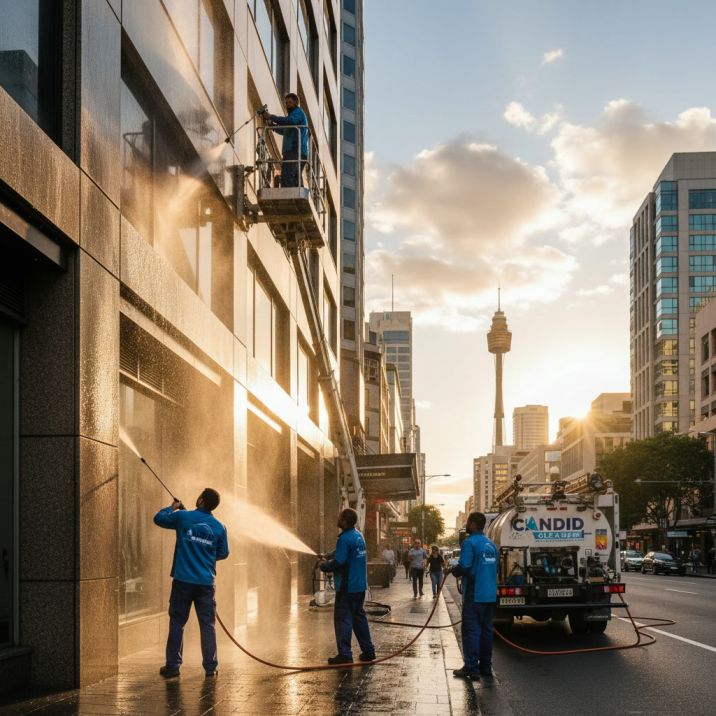
Frequency benchmarks by surface and location, the SWMS legal requirement for above-2m work, the $20M insurance threshold, EPA stormwater compliance, and what distinguishes a professional operator from a non-compliant one
Pressure washing for commercial buildings in Sydney includes more than just booking a team with industrial equipment. Under the NSW Work Health and Safety Regulation 2017, pressure washing work involves construction work and a risk of falling over 2 metres and must have a Safe Work Method Statement (SWMS) issued prior to work commencing. It captures all facade, balcony, and gutter cleaning above ground level.
This guide provides practical cleaning levels for facades, balconies, gutters, car parks and common areas and outlines important WHS and EPA requirements. It also gives a contractor verification checklist for property teams before choosing a suitable provider.
What Commercial Building Pressure Washing Covers in Sydney
Commercial building pressure washing areas in Sydney extend to numerous exterior surfaces, including building facades, car parks, and common strata areas. The correct method will depend on surface, contamination, access, and runoff risks.
Building Facades
Facades include brick, concrete, render, cladding, and painted walls. Mould, algae, pollution, and bird fouling occur faster in Sydney than inland cities because of coastal air and urban traffic. Facade materials help to determine cleaning methods. High pressure can be applied to hard surfaces, whereas soft washing is necessary for render, paint, soft stone, and cladding to avoid damage. High-pressure washing can also cause permanent damage to render.
Car Parks and Hardstand Areas
Commercial building pressure washing includes car parks, loading docks, and hardstand yards. Industrial pressure washers at 3000-5000 PSL with hot water systems aid in removing oil and grease. Water reclamation bunding is also required, particularly when cleaning car parks, because the run-off contains water, chemicals, oils, and other contaminants. Contractors are responsible for preventing this contaminated water from entering stormwater drains under NSW environmental requirements.
Retail Shopfronts and Footpaths
Commercial pressure cleaning Sydney also cleans shops, awnings, entrances, and footpaths. These high-traffic foot areas indicate soiling accumulates more quickly. Contractors should prefer after-hours scheduling because most councils in Sydney require footpath cleaning outside business hours. Contractors also need approval from councils for footpath obstruction. Residential service work includes pressure washing a driveway in Sydney, which is a separate category of service work.
Strata Common Areas
Strata pressure washing in Sydney covers walkways, pool decks, common exterior walls, bin enclosures and basement areas. Owners corporations must maintain common property under Section 106 of the Strata Schemes Management Act 2015.
Industrial and Warehouse Exteriors
Industrial pressure washing Sydney covers warehouse floors and loading bays, yards, and bin compounds. Hot water systems are typically necessary for heavy oil, grease, chemical residues, and biological waste.
How Often Should Commercial Buildings Be Pressure Washed in Sydney?
The right commercial building pressure washing frequency in Sydney will vary depending on location, traffic, surface type, and exposure.
Office and Commercial Building
Schedule regular building cleanings every 6-12 months. Cleaning is recommended for high-exposure sites every 3-6 months. Buildings in areas with arterial roads and near industrial sites require more frequent cleaning because diesel particulate stain builds faster.
Car Parks (Basement and Exposed)
Regularly vacuum and check car parks at the end of every quarter and month for oil, salt, etc. staining. Properties with salt residue, oil spills, and moisture accumulation require more frequent cleaning than inland properties. You should also inspect the car park every month for visible stains. You can increase the cleaning frequency if you notice any visible oil spill, heavy staining, or weather events. For lower traffic sites, a six-monthly schedule may be suitable.
Retail Shopfronts and Footpaths
Clean retail busy areas monthly to quarterly depending on food traffic and trading type. Restaurants have a higher amount of grease and foot traffic in the entrance area, causing the need to clean monthly. Standard retail areas require quarterly cleaning. Also, council complaint requirements in some Sydney LGAs specify the cleaning frequency for footpaths.
Strata Common Areas
Clean high-traffic areas such as walkways, pool decks, and lobbies regularly every 3-6 months. Low-traffic areas need cleaning on an annual basis.
Budget Note: Cleaning may be approximately 8% to 15% of common property maintenance budgets in Sydney CBD strata schemes. You should also consider the anticipated pressure washing cost in Sydney as an annual expense rather than an ad-hoc expense.
The Legal Compliance Requirements for Commercial Pressure Washing in Sydney
Commercial pressure washing legal compliance NSW includes worker safety, insurance, and control of wastewater. The facilities and strata managers must check each requirement before work commences.
Safe Work Method Statement
NSW WHS Regulation 2017 section 80 requires a Safe Work Method Statement for work above 2 metres where there is a risk of a fall. This may include cleaning the facades, roof surfaces, gutters, balconies, and any high-pressure work at common property at height. The site-specific SWMS determines the specific building hazards and controls. However, a contractor who cannot provide a site-specific SWMS before commencing work is non-compliant under NSW WHS law. You should avoid engaging with them.
Public Liability Insurance
Owners corporations must have public liability insurance of $20 million for common property under the NSW Strata Schemes Management Act 2015. For strata pressure washing in Sydney, many strata managers have a threshold of $20 million for contractors on common property. Ask for up-to-date insurance documentation before work commences. Do not accept verbal confirmation. The best practice is to request a certificate annually.
EPA NSW Stormwater Compliance NSW
Commercial pressure cleaning Sydney should ensure that contaminated water does not enter stormwater drains. Oil, chemicals, mould, or biological waste in the runoff must be properly contained and disposed of. Also, professionals always use industrial water reclamation bunding and pump-out systems to contain and dispose of all runoff. Inquire about the contractors’ wastewater management procedure and SWMS documentation before engaging. This documentation will help the building owner if an EPA investigation occurs due to a stormwater incident.
Equipment Requirements – Why Commercial Is Different from Residential
Commercial sites will require equipment capable of accommodating larger sites and heavier contamination. Industrial pressure washing equipment for commercial use in Sydney is rated between 3,000 and 5,000 PSI. Hot water systems will remove oil, grease, and chemical contamination from car parks and hardstand areas. These can be difficult to remove with cold water. The water reclamation bunding and pump-out systems also contribute to the control of contaminated runoff for compliant runoff management.
Residential-grade equipment
Residential units are typically 1,500-2,500 PSI and use cold water. They are suitable for driveways, patios, large facades, car parks, or industrial contamination. However, using a residential-grade pressure washer on a commercial site is not only less effective but also considered non-compliant under stormwater obligations. Before beginning an industrial pressure washing Sydney project, contractors must verify the PSI, hot water capacity, and wastewater management of their equipment.
What to Verify Before Engaging a Commercial Pressure Washing Contractor in Sydney
Before hiring a professional pressure washing Sydney service, facilities and strata managers should check the contractor’s safety, insurance, environmental measures, and quality record. This helps minimize compliance issues and leaves a clear audit trail of contractor due diligence.
Safe Work Method
Ask for a site-specific SWMS before first service. Generic documents do not help to identify the specific hazards for your building. Review fall hazards, harness and anchor needs, chemical handling, and emergency protocols.
Public Liability Insurance
Ask for an existing $20 million PLI certificate for strata common property, or $10 million for other business properties. Ensure you do not rely on old documents or any verbal assurance. Also, check the expiry date of the policy.
Workers Compensation Insurance
A contractor who has staff on site should have workers’ compensation cover under the Workers Compensation Act 1987 NSW. Check existing iCare or WorkCover NSW certificates. However, if any facility manager engages with an uninsured contractor may face liability for worker injuries and their premises.
EPA Stormwater Management
Request written wastewater procedures and SWMS. Specify bunding and pump-out systems, not simply assurances that there will be no runoff. This documentation will protect the building manager if any EPA investigation follows from a stormwater incident to your property.
ISO Certification or Documented Quality Records
For managers looking to verify commercial pressure washing contractor Sydney services, ISO 9001 records can support documented service reporting. This documented report is useful for body corporate, AGM disclosure, and building owner compliance files. Environmental management (ISO 14001) means that the management system has been independently audited.
After-Hours Scheduling for Commercial Buildings – Why It Matters
Most commercial buildings cannot complete pressure washing during business hours. Pedestrian traffic, lobby access issues, and tenant disruption make daytime cleaning impractical, particularly for facades and ground-level areas. After-hours commercial pressure washing in Sydney includes cleaning after hours, typically 6 pm on weekdays or on Saturday. It helps to reduce disruption. Retail buildings should be cleaned before opening to minimise slip hazards on wet footpaths. Also, WHS and public liability require contractors to complete the work before opening. Under the Cleaning Services Award MA000022, penalty rates, loading of between 15% and 25% may be claimed for hours worked. Commercial buildings in Sydney require all contractors to complete the cleaning outside the core business hours. Verify building access requirements and approved contractor hours before work.
Conclusion
Pressure washing for commercial buildings in Sydney demands meticulous planning, appropriate equipment, and compliance checks. Facilities, strata, and building managers should schedule cleaning on the basis of building use, surface type, traffic, and environmental exposure. Check site-specific SWMS, current insurance certificates, workers’ compensation cover, and wastewater management procedures before hiring a contractor. Commercial work also requires appropriate industrial equipment and safe after-hours scheduling. These standards are different from house pressure washing in Sydney, where the equipment is typically smaller and is used for washing smaller areas. Documentation also ensures that the property, workers, tenants, and the surrounding environment are protected.
Frequently Asked Questions
How often should a commercial building be pressure washed in Sydney?
The frequency of pressure washing for most commercial buildings in Sydney is 6 to 12 months. CBD, harbour-facing, high-rise, and retail-facing buildings require cleaning every 3 to 6 months because of pollution, pedestrian visibility, and coastal salt air. Car parks in high-traffic areas of the Sydney CBD require quarterly cleaning to control oil, tyre marks, and moisture.
Is a Safe Work Method Statement required for commercial building pressure washing?
Yes. The NSW WHS Regulation 2017 section 80 states that a SWMS shall be prepared when pressure washing includes a risk of falling from 2 metres. This includes most above-ground cleaning such as facades, balconies, gutters, and higher-level common areas. Contractors are required to submit a site-specific SWMS before commencement. Avoid contractors that do not have one is non-compliant.
What public liability insurance should a commercial pressure washing contractor carry?
For strata common property, the contractor must have $20 million public liability insurance, as the owners corporation has $20 million under its common property insurance under the NSW Strata Schemes Management Act 2015. Typical costs for other commercial buildings are $10 million to $20 million PLI. Always request a current certificate of currency. Do not depend on verbal confirmation.
Can all commercial building facades be pressure washed with high pressure?
No. Concrete, engineering brick, sealed stone and raw masonry can handle high-pressure cleaning. Soft washing, using low pressure and biodegradable chemicals, must be used on rendered walls, painted brick, soft stone, aluminium cladding and heritage brick. High pressure can cause irreversible damage to render. Ensure the proper cleaning procedure for each type of facade material before work.
Why does commercial pressure washing runoff need to be managed?
NSW environmental law prevents commercial pressure washing runoff from legally entering stormwater drains if it contains oil, chemical cleaning agents, mould, or biological waste. Professional operators use water reclamation bunding and pump-out systems to monitor and dispose of runoff properly. To minimize EPA liability to building owners, facilities, and strata managers should ask for documented wastewater procedures.
Common Questions About Pressure Washing For Commercial Buildings in Sydney
What does pressure washing for commercial buildings in Sydney involve?
Pressure washing for commercial buildings in Sydney includes professional high-pressure or soft wash cleaning of facilities, car parks, loading docks, shopfronts, strata common areas and industrial hardstand areas. Commercial units are 3000 to 5000 PSI while residential units are 1500 to 2500 PSI. It also demands that WHS and EPA controls be tightened, such as having SWMS documentation and managing stormwater runoff. Contractors will usually perform work during late hours or on weekends to prevent disturbances. Commercial building contractors also need to have public liability insurance worth $10 million-$20 million.
How often should commercial buildings be pressure washed in Sydney?
Recommended cleaning frequency is site-dependent, depending on the type of building, location, and exposure of the surface. Typical commercial offices usually require a pressure wash once every 6-12 months. Buildings located in the CBD, harbour-facing, high-rise, and retail usually require cleaning every 3 to 6 months due to the high level of pollution and exposure to coastal salt. Quarterly cleaning is necessary for high-traffic car parks in Sydney CBD for oil spills, tyre markings, and moisture. High-traffic areas on strata common areas should be cleaned every 3 to 6 months, and low-traffic areas on the common areas every year.
What legal compliance is required for pressure washing commercial buildings in NSW?
There are three significant legal frameworks related to commercial pressure washing in NSW. A site-specific SWMS is required for all facade, balcony and gutter cleaning that involves a fall risk over 2 metres high as per NSW WHS Regulation 2017 section 80. Strata common property contractors should have $20 million public liability insurance in line with the requirements of the NSW Strata Schemes Management Act 2015. Commercial runoff must also undergo compliant wastewater management and cannot enter stormwater drains. Under NSW environmental law, the runoff from all pressure washing cannot legally discharge into stormwater drains. Before work commences, contractors should present SWMS documents, up-to-date insurance certificates, and wastewater procedures.
What equipment is required for commercial building pressure washing?
Commercial building pressure washing uses industrial pressure washers, which operate at 3000 to 5000 PSI, whereas residential pressure washers are 1500 to 2500 PSI. Hot water systems are used to remove oil, grease, and chemical contamination from car parks and loading docks, as cold water is less effective in breaking down heavy oil residue. There should also be industrial water reclamation bunding and pump-out systems for contractors to contain the water runoff and prevent discharge to stormwater drains under NSW environmental law. The residential equipment is not sufficient for large facades, car parks for commercial buildings, and industrial contamination, and may not meet the induction requirements of commercial site contractors.
What should a strata manager verify before engaging a commercial pressure washing contractor in Sydney?
Before work starts, a strata manager should verify the five critical factors. The first step is to obtain a site-specific SWMS for above-floor work in accordance with NSW WHS Regulation 2017 section 80. Second, check for a current $20 million public liability certificate. Thirdly, check existing workers’ compensation insurance with iCare or WorkCover NSW. Fourth, ask for documented wastewater practices, including EPA-compliant requirements for runoff containment. Fifth, verify the service records for ISO 9001 certification. These records provide an audit trail for strata committee reporting and body corporate compliance files.
Candid Cleaners triple-ISO-certified commercial pressure washing team services Sydney office buildings, strata complexes, car parks, retail shopfronts, and industrial sites, with full SWMS documentation, EPA stormwater compliance, and $20M public liability cover. After-hours available. [Get a free quote →]
