
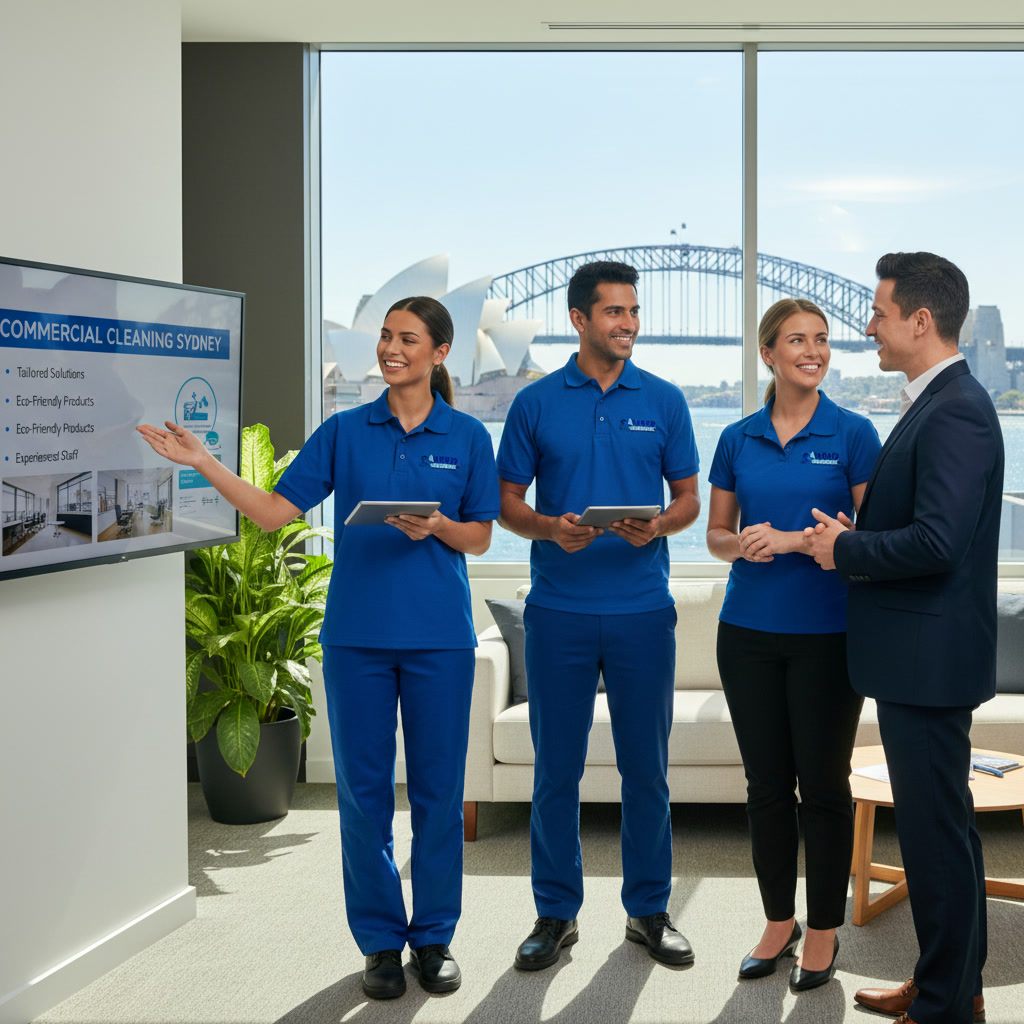
The definition, how it differs from residential cleaning, what it legally involves under NSW WHS law, and the types every Sydney business should know about
Commercial cleaning is systematic maintenance and cleaning of non-residential buildings. Such as offices, hotels, retail stores, strata buildings, medical, restaurant, and other commercial buildings. Unlike residential cleaning, workplace cleaning includes hygiene, safety, compliance, and documented cleaning standards. In simple terms, what is commercial cleaning means services that are planned to maintain the safety, hygiene, and operability of the business premises.
Businesses operating in Sydney must meet NSW Work Health and Safety requirements and industry-specific hygiene requirements. This sector brings together 30,436 businesses with a value of $12.8 billion and over 153,000 employees, including over 35,000 in NSW. This guide covers service types, legal contexts, who needs it, and what to look for.
Commercial Cleaning vs Residential Cleaning — The Core Difference
The key difference between commercial cleaning vs residential cleaning lies in the scale, compliance, and documentation.
- Commercial properties may require cleaning daily or several times weekly on a larger scale than homes.
- The commercial cleaning industry also follows the WHS law, NABERS, FSANZ HCCP, and industry-specific codes. However, there is no equivalent regulatory framework for residential cleaning.
- Documented cleaning schedules, cleaning completion records, and compliance checks may also be necessary for businesses. Such legal or operational requirements are not necessary in residential cleaning.
The difference reflects a regulatory and operational category instead of simply a service preference. Commercial cleaning is classified as an industrial occupation in the ANZSIC code 7321.
Why Commercial Cleaning Is a Legal Obligation in NSW — Not Just a Preference
Poor hygiene can present a risk in the workplace and lead to a breach of commercial cleaning legal requirements in NSW. Employers need to ensure their workplace is free from health risks under the Work Health and Safety Act 2011 NSW and WHS Regulation 2017 NSW. Inadequate cleaning can lead to slips, infestation, pest harbourage, or contamination behind surfaces that can lead to a SafeWork NSW investigation or prosecution. Industry rules may also impose additional responsibilities.
Food businesses need to follow FSANZ standard 3.2.2, and medical facilities adhere to infection control protocols. Commercial strata buildings are required to comply with obligations under Section 106 of the Strata Schemes Management Act 2015. NABERS indoor environment ratings can also impact tenancy value. In addition to legal obligations, ISSA research found that 90% of workers associate cleanliness with productivity, and structured programs could cut absenteeism by up to 46%. Commercial cleaning is also recognised as a separate industry in the ANZSIC code 7321.
The Main Types of Commercial Cleaning Services
There are various cleaning services in Sydney depending on the type of premises, cleanliness requirements, and compliance obligations. The following types of commercial cleaning services in Sydney often cover typical workplaces, specialist facilities, and regulated environments.
Office and Workplace Cleaning
Office cleaning includes vacuuming, mopping, cleaning bathrooms and kitchens, removing bins, and wiping desks. Daily cleaning is common in Sydney CBD offices. Mostly, office management prefers after-hours cleaning to minimise disruption to the work environment.
Commercial Kitchen Cleaning
Cleaning commercial kitchens requires compliance-focused cleaning according to FSANZ Standard 3.2.2 and HCCP requirements. These services also include two-step surface sanitisation, exhaust hood degreasing, and periodic professional deep cleaning. Read our complete guide on cleaning a commercial kitchen.
Commercial Carpet Cleaning
Carpet cleaning companies use encapsulation for regular cleaning and hot water extraction for deep cleaning. Commercial Carpet cleaning is significantly different from residential carpet cleaning. Because it includes specialised methods that are necessary for large areas, carpet fibers, drying times, and slip hazards. Check out our commercial carpet cleaning guide.
Commercial Strata Cleaning
Strata cleaning includes bin rooms, lifts, corridors, car parks, and lobbies. Commercial buildings require cleaning practices that comply with section 106 of the Strata Schemes Management Act 2015 and 2025-2026 NSW strata contractor disclosure reforms. For more details, read our commercial strata cleaning in Sydney.
Industrial and Warehouse Cleaning
Heavy duty cleaning of industrial cleaning includes floor scrubbing, degreasing cleaning around machinery, and hazardous material cleaning. These environments require specialist equipment and WHS-trained cleaners beyond standard cleaning.
Medical and Specialist Facility Cleaning
Medical facilities need trained cleaners, TGA-registered disinfectants, infection control protocols, and recorded cleaning inspections. Clinics, dental practices, aged care centres, hospitals, and childcare facilities generally require this type of service.
Grease Trap Cleaning
Grease trap cleaning is the process that reduces fats, oils, and grease from commercial kitchen systems. Food businesses require this professional service to meet Sydney Water trade waste requirements and relevant Australian standards. Check our detailed guide on commercial grease trap cleaning in Sydney.
NABERS indoor environment ratings also assist businesses to evaluate the environmental quality of their workplace.
Who Needs Commercial Cleaning in Sydney?
Businesses who needs commercial cleaning in Sydney typically include offices and corporate buildings in the CBD and suburbs, retail outlets, shopping centres, restaurants, cafes, and hotels. It also includes medical and childcare facilities, schools, universities, factories, manufacturing centres, gyms, commercial strata buildings, and mixed-use properties. Also, there is separate construction cleaning which is required on construction sites.
Commercial cleaning doesn’t only serve large corporations. Even a 50-person office, dental practice, suburban practice, or a small restaurant requires you to meet workplace hygiene and WHS cleaning requirements. Business size does not reduce these legal obligations. Every workplace has to keep up with these conditions to respond to cleaning hazards that could impact employees, visitors, customers, or contractors.
What Commercial Cleaning Actually Involves — Services and Deliverables
Commercial cleaning packages include daily vacuuming, mopping, and relining waste bins, and sanitising bathrooms and kitchens. It also includes dusting surfaces that can be accessed and cleaning internal glass and mirrors. These services explain what does commercial cleaning includes in a standard package. Some packages also include supplies such as toilet paper, hand soap, and garbage liners, but providers may charge extra for these items.
Periodic services, which are scheduled less frequently, may include carpet extraction, external window cleaning, high-level dusting above 2 meters, exhaust hood and ductwork cleaning, and pressure washing. Specialist services can also cover HACCP kitchen documentation, TGA registered medical disinfection, grease trap pump-outs, and post-construction cleaning. To learn more about these services along with pricing, check out our guide to commercial cleaning costs in Sydney.
What to Look for in a Sydney Commercial Cleaning Provider
To choose a commercial cleaning provider in Sydney, you should check the paperwork for coverage, safety measures, service details, and quality records before signing a contract. Consider the following five points.
- Public liability insurance: Check for a certificate of currency with a minimum of $10 million to $20 million coverage.
- Workers’ compensation insurance: If the provider has employees, verify the mandatory workers’ compensation insurance.
- WHS compliance: Request a written SWMS for any work with a fall hazard greater than 2 metres.
- Written scope of work: A professional cleaner provides a detailed written scope before signing the contract.
- Quality documentation: ISO 9001 providers keep documented service records.
Candid cleaners hold triple accreditation including ISO 9001, ISO 14001, and ISO 45001. The standards apply to quality and consistent documentation, environmental management, and workplace safety, respectively. Read more about commercial cleaning services in Sydney.
Conclusion
All in all, commercial cleaning helps businesses to keep premises clean, safe, and compliant. It includes floor cleaning, refuse removal, bathroom sanitising, surface cleaning, and specialist cleaners for kitchens, medical facilities, buildings, and industrial sites. Businesses operating in NSW should also meet WHS legal obligations and industry-specific requirements. The right provider should also have appropriate insurance, transparent service offerings, safety protocols, and quality records. Whether it’s a small office or large facilities, selecting the right cleaning service plays a vital role in maintaining a safe, clean, and efficient environment.
Frequently Asked Questions
What is commercial cleaning?
Commercial cleaning refers to the systematic and professional cleaning of commercial premises. Such as offices, warehouses, retail outlets, strata buildings, medical centres, and restaurants. Unlike residential cleaning, it complies with NSW WHS law and industry hygiene codes and is documented with an audit. The industry is classified under the ANZSIC Code 7321 and contributes more than $12.8 billion per year to the economy.
What is the difference between commercial and residential cleaning?
Commercial cleaning is based on the WHS Act 2011 NSW, FSANZ food safety standards, HACCP documentation rules and industry hygiene codes. Residential cleaning is about aesthetic cleanliness rather than there being any comparable legal requirements. Commercial services also need documentation, specialist equipment and trained staff. Residential cleaners are not legally or operationally equipped to clean commercial premises.
Is commercial cleaning legally required in NSW?
Yes. The Work Health and Safety Act 2011 (NSW) has a primary duty of care for employers to provide a safe workplace free from health risks. Slip hazards, pest harbourage or contaminated surfaces may occur as a result of poor cleaning and the breach of WHS duties. Food businesses should also meet the FSANZ Standard 3.2.2, under Section 106 of the Strata Schemes Management Act 2015, which applies to strata buildings.
What types of commercial cleaning services are available in Sydney?
Sydney businesses can select office cleaning, workplace cleaning, commercial kitchen cleaning (FSANZ and HACCP compliant), strata common area cleaning, industrial and warehouse cleaning, medical and specialist facility cleaning (requiring TGA-registered disinfectants), and grease trap pump outs. Equipment, compliance, and staff training are different for each service.
What should I look for when choosing a commercial cleaning company in Sydney?
Ensure public liability insurance is held for at least $10 million and ask for a certificate of currency. Check workers’ compensation insurance, WHS documents and SWMS for above-floor work. Always ask for the scope in writing before signing. The presence of ISO 9001 indicates that the processes are documented, and the presence of ISO 9001, 14001 and 45001 together indicates strong compliance systems.
What is commercial cleaning?
Commercial cleaning is the professional cleaning and maintenance of non-residential buildings. Such as offices, factories, shops, strata buildings, hospitals, restaurants, schools, or commercial buildings of any kind. It’s defined as part of the Australian Industry Classification (ANZSIC) 7321. The sector contributes more than $12.8 billion per year through 30,463 registered businesses and 153,000 employees. Unlike residential cleaning, commercial cleaning is governed by NSW WHS law, FSANZ Standard 3.2.2, HACCP requirements, and third-party audits. Commercial cleaning also involves documented schedules, completion records, and compliance checks, which do not apply in residential cleaning.
How is commercial cleaning different from residential cleaning?
Commercial cleaning and residential cleaning are different in terms of regulation, scope, and documentation. Aesthetics is the primary focus in residential cleaning without any regulatory framework or compliance obligations. Commercial cleaning is conducted according to the Work Health and Safety Act 2011, WHS Regulation 2017, and industry hygiene codes. Food businesses are required to comply with FSANZ Standard 3.2.2 and strata buildings must comply with the Strata Schemes Management Act 2015. Commercial cleaners also provide cleaning schedules and completion records and quality checks that residential cleaners cannot provide. The Australian taxation system also categorises residential and commercial cleaning under separate ANZSIC codes as different economic activities.
Is commercial cleaning legally required in Australia?
Yes, NSW law does mandate employers to provide safe workplaces, including appropriate hygiene and cleaning regimes. Employers are under a primary duty of care under the Work Health and Safety Act 2011 and WHS Regulation 2017. Poor cleaning can lead to slip hazards, contamination, and provide harbourage for pests, and fail to meet workplace health and safety obligations. Food businesses will need to comply with FSANZ Standard 3.2.2, strata owners corporations will need to comply with Section 106 of the Strata Schemes Management Act 2015, and healthcare facilities will need to comply with the relevant infection control protocols.
What are the types of commercial cleaning services in Sydney?
Commercial cleaning services are available to Sydney businesses depending on the type of facilities and compliance requirements. Office cleaning refers to the maintenance of the premises as a part of the normal daily routine. Commercial kitchen cleaning is carried out according to FSANZ Standard 3.2.2 and HACCP requirements, including a two-step clean and sanitise process. Carpet cleaners use encapsulation for regular maintenance, and hot water extraction for deep carpet cleaning. Common property is cleaned as part of strata-titled buildings under section 106 obligations. Some industrial cleaning involves degreasing and scrubbing floors. TGA-registered disinfectants and infection control records are required for medical cleaning. Grease trap pump-out supports Sydney Water requirements for food businesses producing fats, oils, and grease.
What do 90% of employees say about workplace cleanliness?
According to ISSA research, 90% of staff report that workplace cleanliness has a direct impact on their productivity. Additionally, the research states that structured commercial cleaning and disinfection programmes can cut down on employee absenteeism up to 46%. These results correlate workplace cleanliness to business performance and not just appearance. Good hygiene not only lowers the risk of pathogen spread but can also respond to chemical and physical hazards in the workplace while allowing staff to work more effectively. Therefore, businesses can consider cleaning standards as an aspect of workplace health, productivity and daily activities.
Now that you know what commercial cleaning involves, see how Sydney’s only triple-ISO-certified commercial cleaning team can service your premises. [Get a free quote →]
